Showing posts with label AIFS. Show all posts

Thursday, February 2, 2023

How to Travel Across Europe Like a Pro

One of the perks of choosing Europe as your destination to study abroad is the accessibility to travel to other European countries and cities. During my 2022 semester abroad in Barcelona, I  was able to visit 9 countries and 14 cities in a matter of three months. I’m going to be sharing with you some travel must-knows and secrets into traveling like a Pro.  


  1. When booking for flights and places to stay, make sure to set your browser to private so the prices are reflected accurately. 

  2. Be sure to check out the cost of both flights and trains. Most times, flights are actually cheaper than trains are and take less time. Be sure to take a train somewhere in Europe at least once for the experience. 

  3. Some expensive locations to be aware of to book early are Amsterdam, Scotland, London, and Switzerland. The airfare and cost of finding a place to stay rise quickly and drastically, so plan ahead to find cheaper dates to travel here. 

  4. When you arrive at your program abroad, everyone is going to be frantically inviting you on trips and booking them day after day. It is going to feel overwhelming and hectic, so make sure to relax and take a step back. Think about where you want to go, with the people you want to travel with and book on your own terms. Don’t feel pressure to follow the crowd. 

  5. When I was studying abroad, hostels cost the same price as a hotel or an airbnb. I only ended up staying in a hostel once. Make sure to check out your options to see your best deal. 


My Top 3 Recommendations for Weekend Trips: 

 Soller, Mallorca


Modes of transportation: Boat or flight. 

Flight cost (on average): 70-100 Euros Roundtrip

Cost of traveling here is always decently low-priced. Check out the prices to find the cheapest date that works for you.

Must-Do’s: Most people visit Palma when they travel to Mallorca but I’ve found the hidden gem of the island to be Soller. Fly into Palma and take a historic train ride to the town of Soller. Once there you can take the Soller train to Port de Soller. Here you can go on a boat ride, see the orange trees, lounge by the beach and take in the views. I recommend staying in the town of Soller to experience the cobblestone streets, local bands, the Parroquia de Sant Bartomeu de Soller, and delicious restaurants.   


Interlaken, Switzerland

Modes of transportation: Flight 

Flight Cost (on average): 125-175 Euros Roundtrip

Book at least three weeks to one month in advance, as prices can rise.

Must-Do’s: 

  1. Go on some sort of adventure while you’re here: Skydiving, skiing, paragliding, kayaking, etc. I took a boat on Lake Brienz that took us to Giessbach where we visited a fairytale looking castle- hotel and a waterfall. It is reasonably priced, makes multiple stops along the way, and is absolutely breathtaking. 

  2. Take a funicular up to Harder Klum and enjoy fondue on the highest point in Interlaken. 

  3. Eat Swiss chocolate! Check out ‘Funky Chocolate’ and order the strawberries covered in chocolate, it will change your life I swear.    


Seville, Spain  

Modes of transportation: Flight or Train (Both are similar in price)  

Flight cost (on average): 80-125 Euros Roundtrip

Depends on where you are in Europe. Cost is low if you are already based in Spain but because it’s in the South of Spain, prices can go up. 

Must-Do’s: 

  1. Visit the Royal Alcazar of Seville to see gorgeous gardens and filming spots from Game of Thrones. While there, find the Baths of Dona Maria de Padilla for a breathtaking experience like no other. 

  2. Pay a small admission fee to visit the Cathedral de Seville and climb stairs to the top for a 360-view of the entire city. 

  3. Watch local Flamenco dancers perform at La Plaza de Espana and grab lunch in a nearby neighborhood.  

Besides the obvious must-see cities, like Paris, London and Rome, other special European gems high on my list are Amsterdam, Porto Portugal, Dublin and Galway Ireland, Brussels, Belgium, Venice, Italy, and The Scottish Highlands in Scotland. 


Written By: Emma Williams, Barcelona Spain, AIFS Abroad

Insider Tips and Tricks to Discover all that Barcelona has to Offer


Barcelona is a bustling city, filled with beautiful Gaudi architecture, incredible Mediterranean cuisine, and the awe of Catalan culture. In comparison to traditional European cities, like London, Paris or Rome, Barcelona is unique in its own way, having the city, mountains and beach all in one (just like Oahu). Don’t expect cobblestone streets around every corner or for everyone to be fluent in the English language.

At first, it may feel like a prettier, cleaner NYC (or at least this was my first impression), but once you adapt you can discover its special, hidden secrets that have made this one of my favorite European cities. I’m going to share with you some tips and tricks that I wish I knew before my first week in the city, as well as some must do recommendations! 


Tips & Tricks: 

  1. Be sure to join in at least one of the local festivities, markets and parades happening around the city. The tradition of the Giants and the Human Towers are two Cataland traditions not to be missed.  

  2. When buying your metro card, be sure to buy the 3-month pass so that you won’t have to keep refilling it month per month.  

  3. If you’re feeling culture shock or homesickness, try out the 5 R’s of culture change exercise: Reflect on each of the 5Rs of Culture Change for your situation specifically.  What are the changes you have faced or will likely face in each of these areas?  Be as specific here as possible.  List the routines you are not able to continue, the relationships that are likely to change the most, etc.  Then note why this is significant for you.  If you find this change stressful, how is this stress manifesting itself in you?  What now:  What are one or two things you are either doing or can commit to doing that will best help you manage this element of culture change? This will help you adapt to your new surroundings and allow you to become more interculturally aware. 

  4. Pickpocketing is common in Barcelona, but it’s not as scary as it sounds. Don’t make yourself a target, hold your valuables where you can see them in busy/touristy areas (Sagrada Familia or the metro), don’t carry your cellphone in your back pocket, and purchase a bag or backpack that is more protective than a tote bag (Has zippers, buckle, etc.) 

  5. Learn basic Catalan phrases and greetings. If you aren’t fluent in the Spanish language that is perfectly okay! Don’t be afraid to greet in Spanish and then speak the rest in English. The locals appreciate when you try and give your best shot, even if it isn’t right. 

  6. Don’t be afraid to introduce yourself to others studying abroad, especially if you’re going abroad alone. Everyone is looking for a friend during these times and they’ll appreciate you introducing yourself. 


Barcelona Recommendations:

  1. Visit the Sagrada Familia at sunset. Arrive 30 minutes before sunset to witness the glass-stained windows change color before your eyes.

  2. Take a day trip to Barceloneta Beach. Check out the restaurants by the harbor, the skateboarders performing, or the Barcelona aquarium. 

  3. Take the train to Sitges, a nearby coastal town filed with windy roads and beachside restaurants

  4. Check out the town of Tarragona for some local history, festivities and cobblestone streets

  5. If you are missing Hawaii’s acai bowls, check out Almalibre Acai House in the neighborhood of Girona. Afterwards, visit Mercat de la Concepcio, the neighborhood’s local marketplace for fresh meat, produce and an endless selection of plants and flowers. Be sure to take a short stroll from the Girona neighborhood over to Passeig de Gracia for some shopping. 

  6. If you’re looking for those cobblestone streets and narrow walkways, visit Barcelona’s Gothic Quarter. For a small fee, you can visit the Cathedral of Barcelona and see Barcelona from its rooftop. Trust me, it’s worth it. While in the Gothic Quarter, you can visit the Picasso Museum or an array of local art galleries.   

  7. If you’re missing nature, check out Parc de la Ciutadella to see a beautiful fountain and sculptures. Pack a picnic and a good book to join the locals for the afternoon. 

  8. Gather your friends and visit Tibidabo Amusement Park for great views of the city and fun-filled rides.  

  9. One of my favorite spots for local eateries and hangout spots is the neighborhood of Gracia. Sit outside at a restaurant, introduce yourself to locals and make sure to be respectful of the area as it's very residential and family-oriented. 


Written By: Emma Williams, Barcelona Spain, AIFS Abroad


Sunday, June 12, 2022

Recap

 Adventure is out there...


Each time something cool happens, I try to take note of it on my way to or from my experience. I find my solace on a bus, train, flight, river, or underground. This recap blog is a lazy composition of a few of my excerpts. Though it's hard to keep track of all this in a consistent and careful way, at least something is better than nothing.


5.27.2022

Trip to Cambridge, England. Saw the school.


5.28.2022

Trip to Edinburgh, Scotland. Had a cup of coffee, found a hostel, made friends in a pub, climbed many hills, cheered on marathon runners, got free drinks from Marta.


6.03.2022

Sooooo...I was on my way to afternoon tea, when I decided tea is not quite enough for lunch so I’ll get myself a pizza beforehand. When I got my pizza, I opened it up to find it was shaped as a heart. How sweet, I thought! They make heart shaped pizzas in England. Then, when I looked at the top part of the box I saw that THE ITALIAN BOY WHO MADE MY PIZZA HAD WRITTEN HIS NUMBER, NAME AND A HEART ON THE BOX. He made the heart-shaped pizza for me. Ohhh. The phone number he left was from Italy and I’m still hesitant to message.


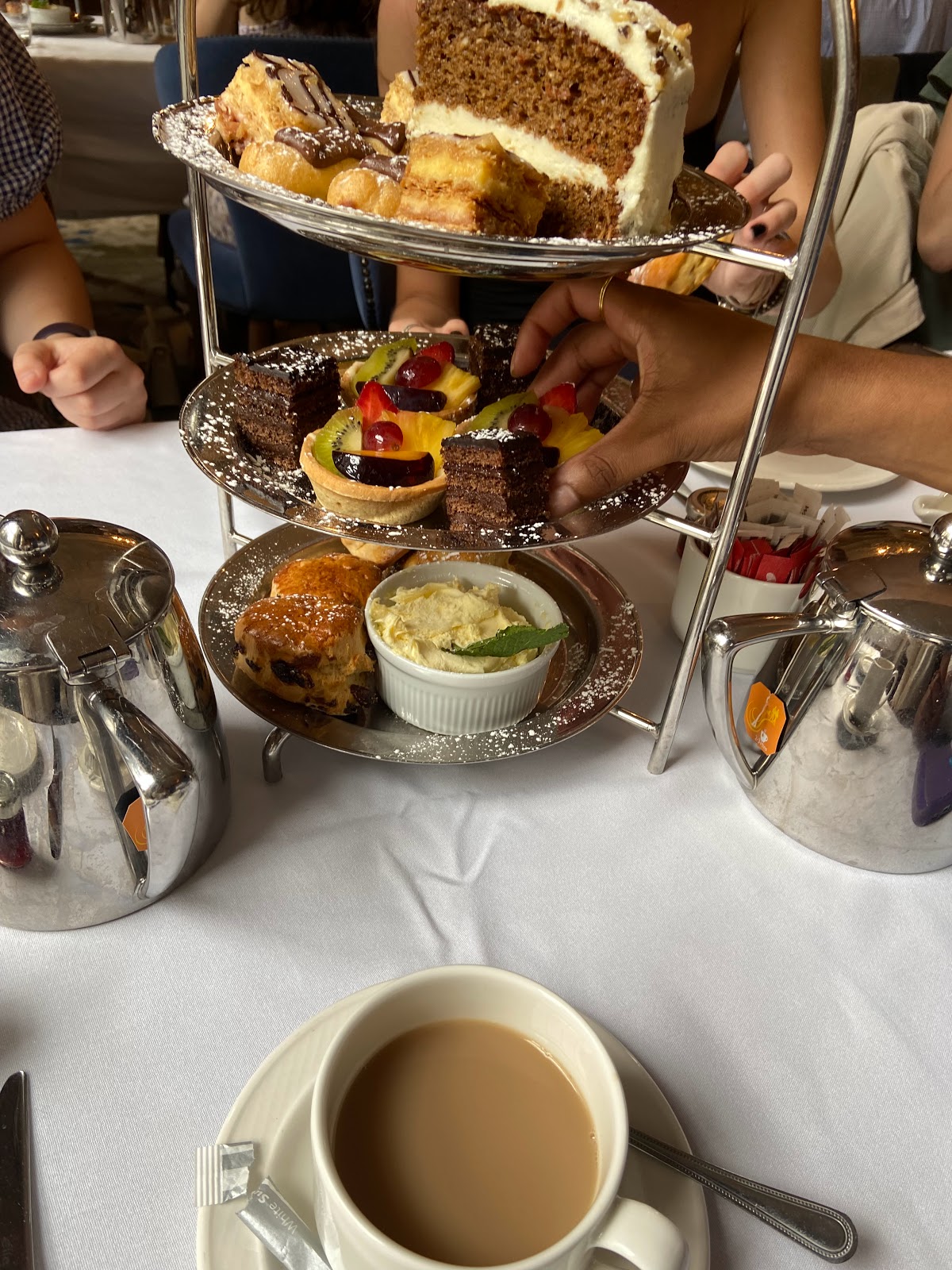
After the pizza, I had my nice afternoon tea date with the girlies, and proceeded to spill more tea than I drank. If you know what I mean.


6.04.2022

Experienced a Mama Mia musical. SO CUTE. I am saying farewell to the session one students as they fly home tonight.


6.07.2022

I went to the Tate Modern Museum to see the 2001 Babel Sculpture, which I loved, but I took an interest in the Monument for the Living. The sculpture “Monument for the Living '' was made by Marwan Rechmaoui in the year 2000. This piece represents diversity as the intersecting of different identities and characteristics. The sculpture is made of concrete and wood, replicating the Burj El Murr building in Beirut, Lebanon. Burj El Murr was built in 1974 with the intention of becoming a large office building. The ravages of war left the building unfinished and the office plans were not carried out. During the Lebanese Civil War, it was instead used as a sniper post. The entire evolution of this eerily resilient building greatly represents its environment and people. 


First built to hold office space by a wealthy family in a time of plenty, then filled with ammunition and dead bodies, and later deemed useless and obstructing in the post-war era. Now that the unfinished building can’t be knocked down, it serves as a memorial for the unresolved conflict of the civil war. To me, the building is a great representation of the “elephant in the room”. It's a looming reminder of change that the city is unable to be rid of. 

This historic structure represents many things for the country. Money, strength, neglect, abandonment, unresolved conflict, and death. The prominent building is a display of wealth because it had grandiose expectations. There were constant renovations and a lot of money put into it in order to become a strong office building. Then of course, the war left it neglected and abandoned. The war also left a lingering unresolved conflict and death. In “Monument for the Living”, we see that diversity may be a vast range of experiences all happening at once. 


This was interesting to me as a viewer because I’ve never considered the relevance or depth a sculpture of a building could hold. When I first saw the tower, I noticed that it was tall, sturdy, and jarring. I scoped it out all around and couldn’t think of the beauty or meaning in a tall concrete building. Before I read the description, I didn’t understand it at all. The artist, Marwan Rechmaoui, is from Beirut, and chooses to express Lebanese history through his work. The Lebanese civil war and its interconnected complexities is far out of my world knowledge, yet Beirut’s story traveled all the way to London, and I met in the middle from Hawai’i. That is a diverse interaction in itself.


6.09.2022

Heads up, I wrote this on a train in present-tense speech. Today I am traveling along the sea-to-sea rail service from West Ham station to south end central, to see the sea. I am taking a round trip train for about 1.5 hours total. The ticket was £17.50. We are passing tall green foliage that sometimes let up to reveal a town or forest. The lavender fields have opened up at last, and I want to be in the country as much as possible to explore the fruiting terrain. The closer I get to Essex, the wider the fields get, as the blue sky opens up to accommodate fluffy white clouds. I first catch sight of the ocean at Chalkwell. To my right are beautiful white beach homes surrounded by trees. To my left, flat and glittering cold water. Its good to see the area where I’ll attend school in the Autumn.


6.12.2022

Traveled far south to the lavender fields today. Got lost, had fun. Loved every moment. I hope to buy a film camera soon and capture all this on 35mm so I can keep my phone turned off.


Tuesday, September 4, 2018

Arrival into London!

It has been 24 hours since I first set foot into the United Kingdom, specifically the city of London! Despite a rather nerve-racking 12 hours seated next to a family with a new baby (apparently, it was her 1st flight), I landed in Heathrow Airport at the crack of dawn.


Passing through immirgration checkpoint was a quick ordeal: having ensured I had all of my paperwork and the important admissions letter from Richmond University on hand. Then it was a Uber ride from the airport to Atlantic House, Kensington!


The classic British rain greeted me on cue as I arrived on campus. Checking in with the AIFS staff was a quick ordeal too, as I was handed a welcome pack containing various leaflets about adjusting to life in London, the official program handbook, and my schedule for orientation week. In addition, my Richmond Student ID and housing information was provided. As the weather was not entirely suitable for lugging two giant suitcases to my accommodation at the nearby Ambassador House (my accommodation for the semester), an AIFS staff member very kindly called another Uber for me to transfer myself the last short leg to the front door.

It was fairly easy to locate my room, being on the ground floor it meant I didn't have to sweat even more trying to carry my bags upstairs. As I arrived a day later after the dorms opened, my two other roommates were already settled in: Hugo from Seattle Pacific University and Alexander from Minnesota!  No time to rest though: as soon as I dropped off my bags I walked back to Atlantic House (the main building at Richmond University) to grab some brunch at the Dining Hall, before meeting out front to join my AIFS group to walk over to a nearby hall for an introductory briefing.

Primarily the briefing covered the dos and donts: how to observe the law in the UK from the local Constable in Kensington (complete with horror stories from previous AIFS students), information about getting around town and campus, and an overview for the week ahead. After a short break in between sessions before the next activity, I rejoined the group to walk to the main street of Kensington to hop onto the coach for a tour across London's key sights! Luckily by then, the weather began to clear up and the sun was out!

We managed to visit the primary sights of London during our 3-hour tour, namely Buckingham Palace, St. Andrews Cathedral, and passed by Westminister Abbey and Big Ben (under renovation). Even though I was jet-lagged and tired, I still managed to get some awesome pictures of each site below!


We returned to Kensington in time for dinner. The dining hall I should mention, serves primarily a British menu. So in this case, dinner for me was chips, beans, chicken, peas, potato salad, and veg with soup. Dessert was available, consisting of an ice cream freezer with cones or bowls. I did want a bit of second for dinner but as it turns out, AIFS students are only entitled to one main meal each; any more require you to fork out of your own expenses for.

After a fulfilling dinner, it was time to turn in for the night and rest up for the day ahead. Some people in my group decided to head out to the pub or go out clubbing on a Tuesday night, but I clearly was not in the right mood for that! A warm shower and good nights' rest is what I needed!

Keep an eye out on my upcoming posts on the blog as I delve further into life at Richmond University of London, and exploring London itself!

- Adrian Ma

Friday, May 12, 2017

Quick Thoughts: After Study Abroad

The semester is almost over and Spain will soon become a memory for me. I find myself, in these last two weeks, looking ahead to what needs to be done this summer and next year and...
Before I get ahead of myself (which has definitely happened before), I've had to keep in mind one of the most immediate feats for when I return to the States--reverse culture shock.
I'm not so unfamiliar with this experience as I have had to undergo this process every time I went from Hawaii to Cali, and also from Belize to the States. But I know that will play a huge part in how I deal with stress and with the upcoming school year. So here are some tips for those who are facing big transitions after time abroad OR for those who are interested in studying abroad.

1. Take your time with adjusting. Don't try to do it all at once because believe me, there will be more to get used to than you realize. You'll have to not only readjust to American culture, but also to your family and friends.
2. Accept that this experience has changed you. I'm not saying that your core personality or root of self has changed, BUT after living in a different culture, possibly speaking a different language, and other experiences abroad, may have had an effect on how you see the world and how you interpret cultural differences. You may even have changed your routines and priorities upon your return. You may get bored or be put off by the fact that the people you left behind (friends and family) have more or less been doing the same things. You may feel upset or frustrated because your loved ones don't fully understand your experiences and new behaviors. THAT'S PERFECTLY NORMAL. It happens to every traveler.
3. Be patient and gracious with yourself and with your loved ones. Tension and stress happens, but these two things make it way easier for yourself and for others.
4. Set super-short term goals! These are for all my people who may struggle with anxiety or depression under deep stress. One. Thing. At. A. Time. I have already set mini daily goals to keep myself sane and centered, and to also build healthier habits. For example, I noticed I would pick at my fingers every time I got stressed, worried, bored, lazy, etc. So I began disciplining myself to stop. Overcoming that daily (2 days in a row so far lol) has actually made me more productive and forces me to rely on the fact that I'm not in control, and that what will happen will happen.
5. PRAY. Lastly, for my Christians out there, you all know we a Savior, Father, and Friend who knows us and cares about us. Don't forget to pray about everything, even the little things. I know for me, looking to God for guidance, strength, assurance, and peace has taken load after load off of my shoulders. Also it keeps me centered on the hope that is Christ, which trumps any sort earthly goal I may be worried about. He works all things together for the good of those who love Him, so pray :)

"Therefore do not be anxious, saying, ‘What shall we eat?’ or ‘What shall we drink?’ or ‘What shall we wear?’ For the Gentiles seek after all these things, and your heavenly Father knows that you need them all. But seek first the kingdom of God and his righteousness, and all these things will be added to you.“Therefore do not be anxious about tomorrow, for tomorrow will be anxious for itself. Sufficient for the day is its own trouble." Matthew 6:31-34

Tuesday, May 2, 2017

Lone-Wolf

Travelling alone while abroad, I believe is something truly valuable. While group excursions and organized trips with experienced guides are helpful and at times more educational; the time I have spent, exploring a place on my own, has been so enriching. The past few weekends, I have taken it upon myself to travel to Denia, a precious Valencian pueblo, and Madrid, the capital of Spain.
Both required lots of time sitting on a bus, lots of self-awareness, and lots of prayer. It was my first time travelling alone, and I felt that weight much more during my time in the bustling city of Madrid. But even with the weight of being by myself, I also experienced a release—a paradox that I often feel being an introvert when I have those hours alone. Except this time, it has been days of alone time.
Now when I say alone, I mean not having a travel buddy to see and experience the awe that I had when visiting some of these places. I had God, my boyfriend and my parents on skype, social media, and of course the people sitting next to me on the bus rides and the people in my hostel. And that’s just it, travelling alone gives you the opportunity to appreciate people you have in your life and meet new ones. It forces you to leave your bubble, be unconventional, and get into some socially awkward situations.
Having that time alone to appreciate your study abroad country is something I suggest to any aspiring student. I could see two new sides of Spain.  In Denia, I was welcomed by pastors of the Salvation Army church. Though mentally taxing, pushing myself to get to know new people was enriching as I learned about their family and how small this world is. For example, the father of this Valencian family, is absolutely in love with the Hawaiian hula dance. Being the weekend of the Merrie Monarch Festival, he woke up each morning at 6:00am to watch the live stream in Hilo. I could answer his and his family’s questions about Hawaiian local culture and American culture in general, while they in turn showed me Denia. Not only was there cultural sharing, I spoke Spanish the ENTIRE time, except for the last day there when I found that their daughter knew English. I was blessed by their hospitality and of course the homemade paella and tortilla de patatas (con chorizo!).  I can safely say; I have a family with open arms in Denia that I can visit when I return to Spain.
As for Madrid, there was no familiar church or family that reached out to me. All me for four days. I would say you cannot live in Spain for a semester and not visit the capital. Not having a guide in Madrid, and the necessity of serious self-awareness, forced me to see the city for what it was. I noticed things that with other people, I may not have. I could see what I wanted whenever I wanted. I didn’t have to keep track of people, or try and compromise with anyone on what activity we should do. I could pace myself, rest when I wanted, and you get the picture. While the anti-social side of me was fighting for the spotlight, I had over-zealous people in my hostel and on the bus, that wanted to have a conversation with me (even if I was clearly listening to music, watching a movie, or reading a book). I realized if I stayed in one place long enough, someone was going to talk to me. I had to get over myself, and listening to the elderly Spanish women tell me about her life story and her problems with her daughter; I had to listen to and respond to the women in my hostel about why we were in Madrid, where we’re from, etc. Again, I say though you are technically by yourself, it does not mean you are alone.
Those words are words told to me by my family, church family, my boyfriend, and people close to me, who know that I have struggled with being by myself for long periods of time. I say to them thank you. Through these experiences, I have practiced my Spanish, learned more about Spain, saw some dope art, and have had time of self-reflection.
To those who are hesitant to travel to another country because of fear of being alone, I tell you this: that time alone is a precious treat and opportunity to step away from the hustle of life and pay attention to yourself and others around you. And for my Christian friends who struggle with being alone, remember that God is always with us and that because of our relationship with him, being found in Christ, we can be certain that we are never alone. So, book a ticket, study abroad, even explore your own city by yourself. Appreciate where you are, make the most of it, and rest in the peace and hope of God.

Philippians 4:8-9 Finally, brothers, whatever is true, whatever is honorable, whatever is just, whatever is pure, whatever is lovely, whatever is commendable, if there is anything worthy of praise, think about these things. What you have learned and received and seen in me—practice these things, and the God of peace will be with you.


Saturday, March 18, 2017

Updates and Poetry

    Since my last blog post, I have travelled to Seville and Cordoba, Barcelona, and Morocco. I have had  a birthday, my midterms and fought a small cold. I have been homesick, enchanted and everything in between. And here we are in March, already halfway through my semester abroad!
    The truth is I have started and stopped this blog post many times since our group trip to Seville. Why I had such a massive writer's block escapes me, my topic of interest kept changing and even my poetry wasn't coming together. Now, I feel I've given myself more than enough time to get my thoughts out there for you all to read. This post will consist of my poetry and meanings of said poetry. [Disclaimer: I know my posts so far have come from a sociocultural perspective instead of a traveler's perspective. I'll be sure to include a post about AIFS and different dos and don'ts for those who are considering studying abroad in Granada come next week. Spoiler: would definitely recommend AIFS...to be continued ;)]

Now for those who decided to stick around, some poetry!

Still-life--
I see the food and flatware.
Ah, now I understand the why--
A country's culture framed;
off of the canvas
  see the pomegranate,
     bread and wine stains.
Still life,
  preserved to this day.

    This poem I wrote today, after my trip to the Granada Museum of Fine Arts. There is a fine collection of 16th century to 19th century art that depicts Granada's history and culture. I noticed a progression, seen throughout western art history in Europe. The Gothic and Medieval work included the depiction of Christianity through the lens of Catholicism. I first saw wood-work and paintings of Madonna and Child, Christ's crucifixion, narratives of the life of Christ on Earth.  
     Looking for the resurrection of Christ, I did not find it. Instead, the gallery led me to the beginnings of the recognition of Saints, which did not surprise me. Huge, wooden, polychrome statues of monks and saints; and paintings of their accomplishments. Leading me then to the 17th century works, away from the Bible, away from "piety," and to an exhibition of still-lifes.
     For so long, in my experience with art history, I never fully understood the point of still-life paintings until today. For some reason it clicked in my mind why paintings of food and silver dishes on a table played a role in western art outside of it being just "something to paint."
     What these seemingly mundane portraits of pomegranates and onions, "bread and wine stains," and meat hanging in butcher shops showed me, was a symbolic preservation of not only Spanish gastronomy, but what the people of this country continue to hold dear to. What was depicted in these still-lifes is still a facet of the Spanish lifestyle today. Selling silver was the trade of my Spanish mom, she cooks with most if not all the ingredients depicted in the paintings, and the pomegranate continues to be the symbol of Granada.
     What baffles me most, is how hundreds of years of influence from the Arabs, from the Romans, from the Greeks, and from the Phoenicians is so clearly seen today in Spain. I've yet to experience that in the United States and probably won't in the same way I have here in Spain.

    Just a quick side note, throughout my trips that I mentioned earlier, I have visited museums telling a similar story and have written corresponding poetry that I will feature in my Study Abroad promotion project.

    The following poem is an expression of my take on the Catholic influence in the art and history of Spain. It was clearly a vehicle for the expulsion of dissenting beliefs, the conquest of the Americas, and the rise of Spanish rule in the 15th and 16th centuries. Being a Protestant, I have felt inclined to comment on the representation of Jesus Christ in the art I viewed today.

From the Gothic roots
I saw a progression
  of the Christ-child,
beloved, in mother's embrace
to crucified,
to mini statue of crucifix 
  in the hands of an oversized saint.
What happened to the empty tomb?

Thank you for reading. I would love to hear your thoughts :)

"Do not work for the food that perishes, but for the food that endures to eternal life, which the Son of Man will give to you. For on him God the Father has set his seal." John 6:27

Sunday, February 12, 2017

Disfruta!

Disfruta! or Enjoy!
     The culture of Spain, specifically in Granada, is not one too different from that of other Western countries. The people here work, sleep, eat, and play. Keeping that in mind, I see that the largest difference is that these facets of the society, unlike the United States, are done with a sense of balance.
     Coming from a culture of excess, it is only slightly refreshing to see certain aspects of this society elevated, while others are muted. For example, the food. Each meal I have eaten so far has consisted in excess of the "dreaded" carbohydrates and veggies with significantly less meat. While I prefer excess spice and heat in my food, here seasoning is used lightly.
     In US culture, it seems most people are surviving on some hours of sleep, since work is a high priority. In Granada, rest is crucial as is evident by the four-hour lunch break had by most each day.
Even in the night life, at midnight, I see people of all ages out on the streets eating dinner and going to tapas and bars; while in the US, kids better be in bed by 8:30pm. College students here can hold their liquor, while my American peers seek to indulge themselves most nights.
     Last night was telling at how stereotyped American students are in this part of Europe. For example, on Saturday night my roommate and I were resting, waiting on dinner which starts super late here (normal dinner time is around 9:30 pm). My Senora gets home around 9:15pm to start preparing dinner and asks us, "Chicas, are you going out tonight? You're young and beautiful, you should go out! See Spain!"
*Disclaimer: I am sedentary by default, introverted, and prefer to "see Spain" during lit hours with a few people. I'll maybe go out twice a month for a couple of hours. I do not go wild, and anyone who knows me well, knows this. 
In response to her, I explained my predisposition. Then, she told us about Americans who lived with her in the past, how they went out every weekend and took shots, etc. Of course, she assumes this of college students in general, but especially in that of American students. My roommate and I found it comical that this was the culture we stepped into, where your Spanish mom is telling you to go out and get a little reckless. After dinner that night, I complied to go to tapas with my roommate since we had been home most of the day. Our favorite place for tapas so far is this place called "La Bella y La Bestia." I'll say this, it was nice. We talked about ourselves and had good conversation. She opened up and so did I. We even had the same waiter who remembered us because I was "the-one-who-ordered-a-Coke-without-rum" and she was "the-one-who-got-the-wine-he-recommended".
     In my exploring Spain (during the day) I have met some peculiar people in shops and I have even attended a couple of churches, where I feel I have had the most success in meeting Spanish people (I will write a separate blog post about people who have stood out to me and why). In those simple conversations and positive experiences, I have come to appreciate this culture more.
     I enjoy the company, the moderation, and the slow-paced lifestyle. In those things, I have realized the things I do in excess that may need to change. For example, my desire to stay home all the time or eat a lot of spicy food or even wallowing; all are things that I see do not need to be my default. I can enjoy the things around me. In my personal devotional time with God, I have been reminded even more that all my joy and pleasure is in and from Him. All that is good, is from Him. So I take in the good that this experience has to offer, and I thank God for revealing aspects of His goodness in this precious little city.

"You make known to me the path of life; in your presence there is [fullness] of joy; at your right hand are [pleasures] forevermore." Psalm 16:11

Fruta en todos lados

La Bella y La Bestia

My hood for the next few months


Thursday, January 26, 2017

La Señora

Señora,
    unsure if the language barrier
  bothers you,
but
you've done this many times before.
From the Sierra Nevadas, 
      to the Albaicin barrio,
          to Las Recogidas, 
                                 alrededor a Granada,
I wish to learn and speak
and understand--you.
-Naomi


    My first week in Granada is nearing it's end and I'm keen to share with you all about my experience. I have titled this post "La Señora" because out of all the shock, awe, nervousness, and excitement; my señora and her family are the most interesting of all I've seen and heard in Granada so far. 
     For those who do not know, I am living with a homestay family. In Spain, this "family" is usually a widow, soltera o con sus hijos (alone or with kids), and we call her "señora" as a sign of respect--much like "aunties and uncles" in Hawaii. 
     The biggest and most present challenge of living in Spain, is living with a women, her daughter and her son who are todos Españoles. La Señora Pepa does not speak any English, y sus hijos, María y Juan, only speak some. I have come here to improve my Spanish, but outside of the house, I am tempted to speak only English. This is because I am often surrounded by the American AIFS students in a tour or an outing. I get a pass while I'm exploring with them, but once I'm home, Spanish is the key communicator.
     While it has proven to be challenge for me, especially when I've been tired, I realize that immersion in any country requires patience, effort, and respect for ones' culture. This culture in Granada, in Andalucia, is one that most definitely consists of food and dance and tapas and history, but the root of any civilization's culture is their language. On a day like today, when I had no desire to speak Spanish and butchered the grammar when I did, it is humbling to remind myself that I must build relationships while I'm here. I must get outside of my comfort zone and not only play tourist, but be invested in the people I encounter as well. La Señora Pepa and her family reminds me of that. I am an outsider entering their beloved city and country. The best thing I could share with them is my attention and effort to know who they are. 
Proverbs 16:24 "Gracious words are like honeycomb, sweetness to the soul and health to the body."

View of Granada from Albaicin lookout point

AIFS American Students in front of La Alhambra

Paella Mexicana